SkipQ — B2B Admin Platform
.png)
Project Overview
Designing a scalable post-booking and operations platform for the SkipQ marketplace.
My Contribution
Role
UI/UX Product Designer for the E-Commerce B2B Platform
Project Description
In addition to the customer booking experience, I designed the post-booking support and internal operations platform used to manage bookings, suppliers, customer communication, pricing, and operational workflows across the SkipQ ecosystem.
Project Type
End-to-End Product Design for Internal Operations & Admin Platform
Tools
Figma, Adobe Illustrator, Photoshop, Miro
SkipQ
SkipQ is a cross-platform airport-services marketplace that simplifies booking for travellers while enabling distributors, suppliers, and administrators to manage products, pricing, payments, and operations through a scalable internal platform.

My Process
I followed a user-centred product design process focused on operational efficiency, data visibility, error prevention, and scalable workflows.
.png)
Empathise
The process began by examining the operational challenges faced by administrators and support teams.
Through workflow analysis, stakeholder discussions, and platform audits, I identified pain points related to fragmented booking data, inefficient processes, inconsistent supplier management, and limited visibility across post-booking workflows.
The research focused on how internal teams manage bookings, customer requests, supplier configurations, payments, and operational reporting in their day-to-day work.
Define
Based on the research findings, I defined the core operational challenges and established the primary UX objectives for the admin platform.
Key areas identified included:
- Distributor and supplier management
- Order and transaction visibility
- Wallet and billing operations
- User permissions and access control
- Booking modifications and support workflows
Ideate
During the ideation phase, I explored different dashboard structures, navigation systems, information hierarchies, and reusable management workflows to improve scalability and usability across the platform.
The design process focused on:
- Simplifying complex operational tasks
- Standardizing admin workflows
- Reducing cognitive load
- Improving data visibility and accessibility
- Creating reusable UI patterns for future scalability
Wireframes, user flows, and information architecture diagrams were created to validate navigation structures and optimize how administrators interacted with operational data across different management areas.
Prototype and Test
High-fidelity prototypes were developed to simulate real operational workflows across distributor management, supplier management, order management, wallet and billing systems, and reporting dashboards.
The prototypes focused on:
- Responsive admin layouts
- Scalable table and data management systems
- Clear visual hierarchy
- Efficient navigation patterns
- Reusable components and design consistency
- Simplified multi-step operational workflows
The final stage involved evaluating usability, validating workflow efficiency, and refining interaction patterns based on stakeholder feedback and operational requirements. The testing process focused on identifying friction points within high-volume operational tasks and improving clarity across data-heavy management interfaces.
Problem and Goal
.png)
Challenge
The main challenge was designing a flexible admin experience capable of handling multiple supplier integrations, dynamic booking data, post-purchase modifications, support workflows, and operational visibility within a unified system.
Key focus areas included:
- Booking management workflows
- Supplier and product administration
- Dynamic pricing and markup controls
- Customer support operations
- Post-booking modifications and cancellations
- Dashboard and reporting experiences
- Scalable internal tooling and reusable components

Project Goals
The goal was to create a clear, intuitive, and scalable operational platform that reduced complexity for internal teams while supporting business growth and future supplier expansion.
Design System
To support a scalable multi-supplier platform, I developed a unified design system focused on consistency, usability, and efficient cross-platform implementation. The system included reusable UI components, standardized interaction patterns, responsive layouts, and flexible design foundations capable of supporting complex booking and operational workflows across the platform. The design system established clear guidelines for typography, spacing, color usage, accessibility, and component behavior, helping create a more predictable and cohesive user experience across customer-facing and internal admin environments. Reusable components and scalable UI patterns also improved collaboration with developers, reduced repetitive design work, and streamlined future product expansion and supplier integrations.
.png)
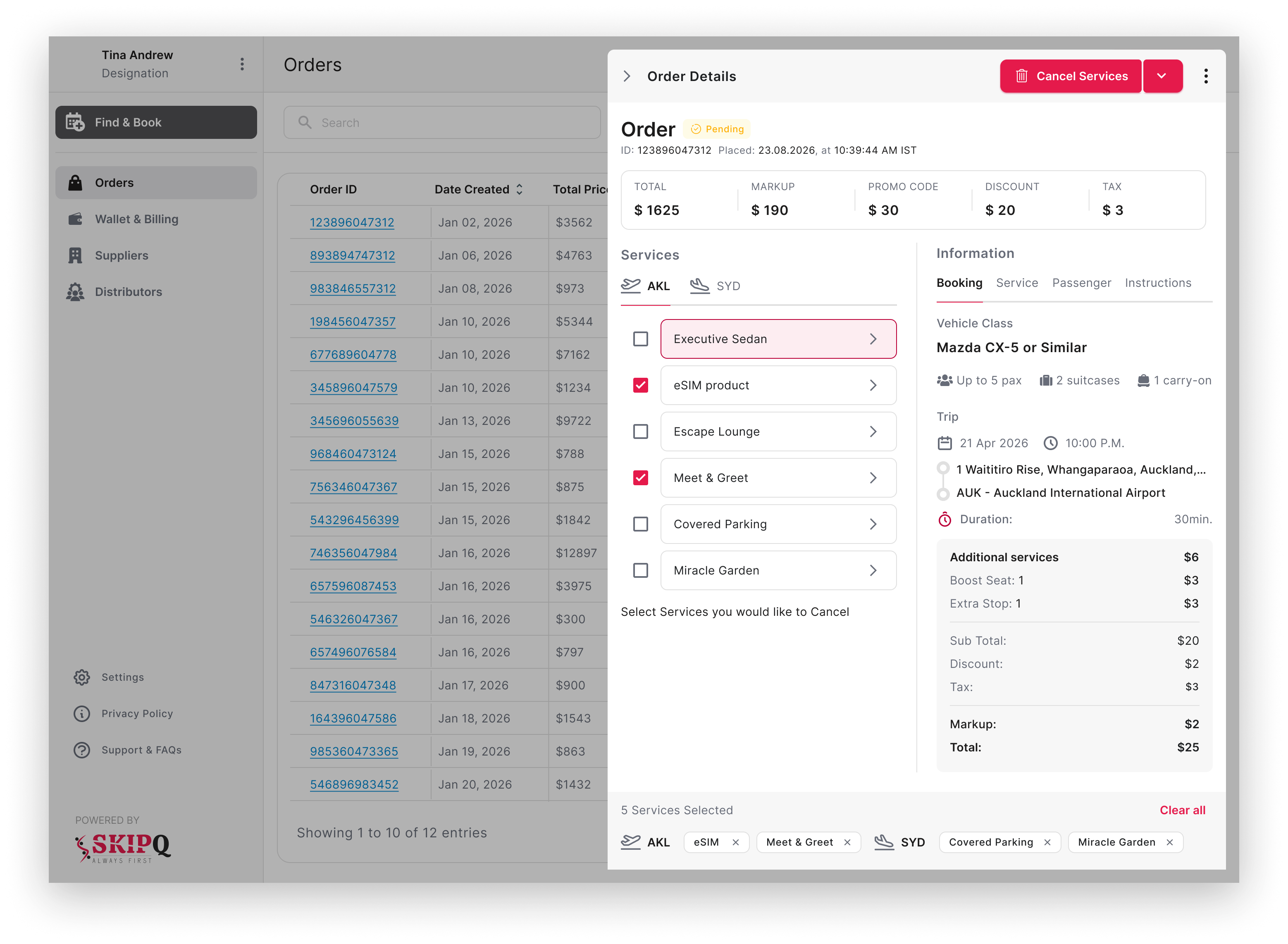
Order Management
The Order Management experience gives the SkipQ operations team a centralised, scalable system for managing bookings throughout the post-purchase journey. Administrators can monitor orders, update statuses, coordinate with suppliers, process refunds, modify bookings, and support customers. The experience improves visibility across supplier integrations while simplifying high-volume operational workflows.
.png)
.png)
.png)
Wallet and Billing
The Wallet and Billing experience simplifies payment management for SkipQ’s internal operations teams. Administrators can monitor wallet activity, manage billing workflows, respond to payment-related customer requests, and review transactions across suppliers and services. The system supports scalable financial operations while maintaining consistency, security, and usability.
.png)
.png)
.png)
.png)
.png)
Distributor Management
The goal was to create a scalable and intuitive admin platform that streamlined distributor operations:
Key Features
- Distributor account management
- User roles and access permissions
- Order and transaction visibility
- Documents and verification management
- Activity history and audit tracking
- Internal notes and communication records
- Reporting and operational dashboards
.png)
Supplier Management
The Supplier Management platform was designed to streamline the onboarding, configuration, and operational management of multiple third-party suppliers integrated within the SkipQ marketplace. Since suppliers operated across different service verticals with varying booking structures, APIs, and operational requirements, the experience focused on creating a scalable and standardised management system.
Key features included:
- Supplier onboarding and configuration
- Product and service management
- Dynamic pricing and markup controls
- API and booking flow management
- Operational monitoring and reporting
- Service availability management
- Supplier-specific workflow customisation
Final Outcome
The SkipQ Admin Platform was designed as a scalable internal operations system supporting the broader SkipQ services ecosystem. In addition to the customer booking experience, the platform was built to help administrators manage bookings, products, pricing, customer communication, and operational workflows through a centralised management interface.
I worked closely with the SkipQ team throughout the entire process to understand business requirements, operational challenges, and user needs in order to translate complex workflows into clear, intuitive product experiences. Together, we defined the functionality, structure, and user flows required to support both current operations and future scalability.
.png)