SkipQ — B2B Travel Marketplace
.png)
Design Challenge
How might we create one clear, predictable booking experience while supporting the different data, validation, and operational requirements of 21 suppliers?
My Contribution
My Role
I worked as the UI/UX Product Designer, leading the end-to-end design of SkipQ’s B2B marketplace booking experience.
Project Description
SkipQ aggregates airport services from 21 suppliers across seven verticals, including eSIMs, parking, lounges, fast track, meet and greet, transfers, and attractions. The design challenge was to unify different search requirements, product structures, booking flows, checkout rules, and API limitations without exposing that complexity to users.
Project Type
End-to-End Product Design for a B2B Marketplace
Tools
Figma, Adobe Illustrator, Adobe Photoshop, and Miro.
SkipQ
SkipQ brings airport services—including lounge access, meet-and-greet assistance, transfers, eSIMs, and more—into one marketplace. The platform helps travellers prepare for their journeys while connecting retailers, airports, suppliers, and service providers through a unified digital experience.

My Process
I used a user-centred product design process to turn fragmented supplier journeys into a scalable, consistent booking framework.
.png)
Supplier Experience Audit
I audited every supplier integration to identify shared booking behaviours, flow inconsistencies, required data, technical constraints, and supplier-specific edge cases.
Key insight
Although the integrations differed technically, most journeys followed five common stages:
- Search
- Product selection
- Passenger details
- Checkout
- Confirmation
This shared model became the foundation of the unified booking architecture.
Booking Flow Standardisation
I designed a consistent booking structure across all seven service verticals to reduce friction and make each journey easier to learn.
Standardised flow
- Search
- Search results
- Product selection
- Product details
- Passenger information
- Checkout
- Confirmation
The shared structure created familiarity and predictability regardless of product type, supplier, or country.
Flexible Component System
Because suppliers required different booking inputs, a rigid interface would not scale.
System capabilities
- Dynamically rendered fields.
- Optional content support.
- Flexible layouts for supplier requirements.
- Coverage for different booking scenarios.
Reusable components
- Search modules.
- Product cards.
- Step indicators.
- Dynamic forms.
- Checkout summaries.
- Status messages.
- Error states.
The modular system improved scalability, consistency, and development efficiency.
Reducing Cognitive Load
The platform contained complex booking logic, but users should never feel that complexity.
Design approach
- Progressive disclosure.
- Step-by-step booking flows.
- Contextual validation.
- Clear visual hierarchy.
- Persistent booking summaries.
User benefits
- Users stay oriented throughout the journey.
- Users can understand their progress.
- Users can complete bookings more efficiently.
Problem and Goal
The project required a flexible system that could simplify fragmented supplier experiences without losing essential booking rules.

The Challenge
The platform relied on third-party integrations designed independently with different booking structures, terminology, validation rules, and checkout requirements. These inconsistencies fragmented the customer journey and increased friction.
Key problems
- Inconsistent journeys across suppliers.
- Unpredictable booking and checkout flows.
- Complex forms and validation patterns.
- High cognitive load for users.
- Limited scalability and development efficiency.

Project Goal
The goal was to create a unified, scalable booking experience that simplified complex workflows while remaining flexible enough for different suppliers and booking scenarios. The solution needed to improve usability, reduce friction, and establish a predictable interaction model.
User Flow and Information Architecture
I created a user-centred information architecture that standardised the booking experience across third-party integrations. It defined the core booking stages, shared interaction patterns, and reusable components needed to reduce cognitive load while supporting flexible supplier requirements.
.png)



Design System
I defined reusable foundations, components, states, and interaction patterns to maintain visual and functional consistency across every booking flow.
.png)
.png)





.png)

Search and Product Discovery
I designed the experience around progressive disclosure. Users first select an airport to view available services, and the interface then reveals the booking requirements relevant to the selected product. Consistent product-card structures and information hierarchy create a unified browsing experience across all services.
.png)
.png)
.png)
.png)
.png)
.png)
Booking Details
Passenger count is collected during search. The system then displays the appropriate passenger-information form for individual travellers, groups, or passengers with children. For multiple services in the cart, users complete passenger information for each service, grouped by airport. They can save passenger details and apply them across services to avoid entering the same information repeatedly.
.png)
.png)
.png)
.png)
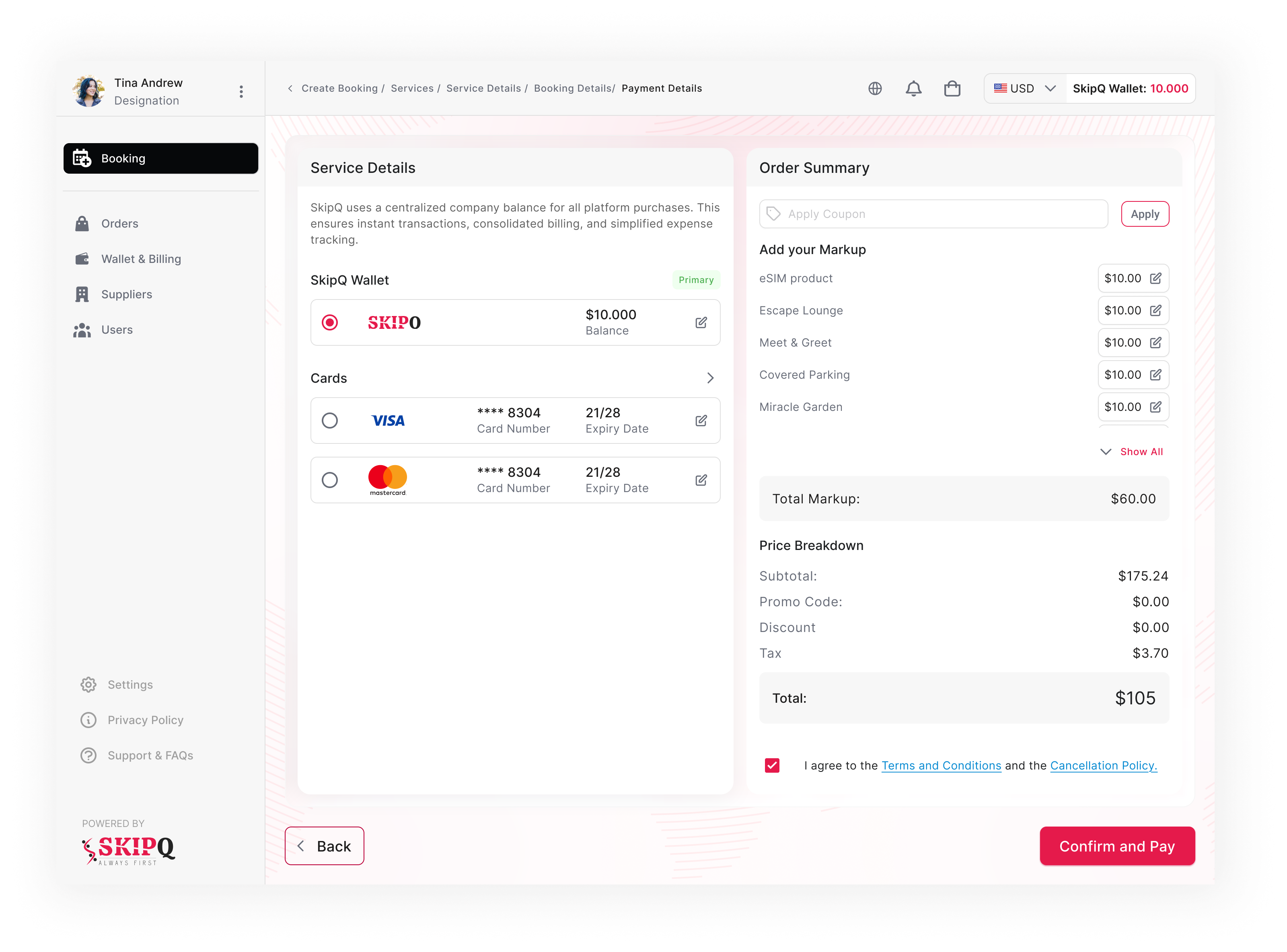
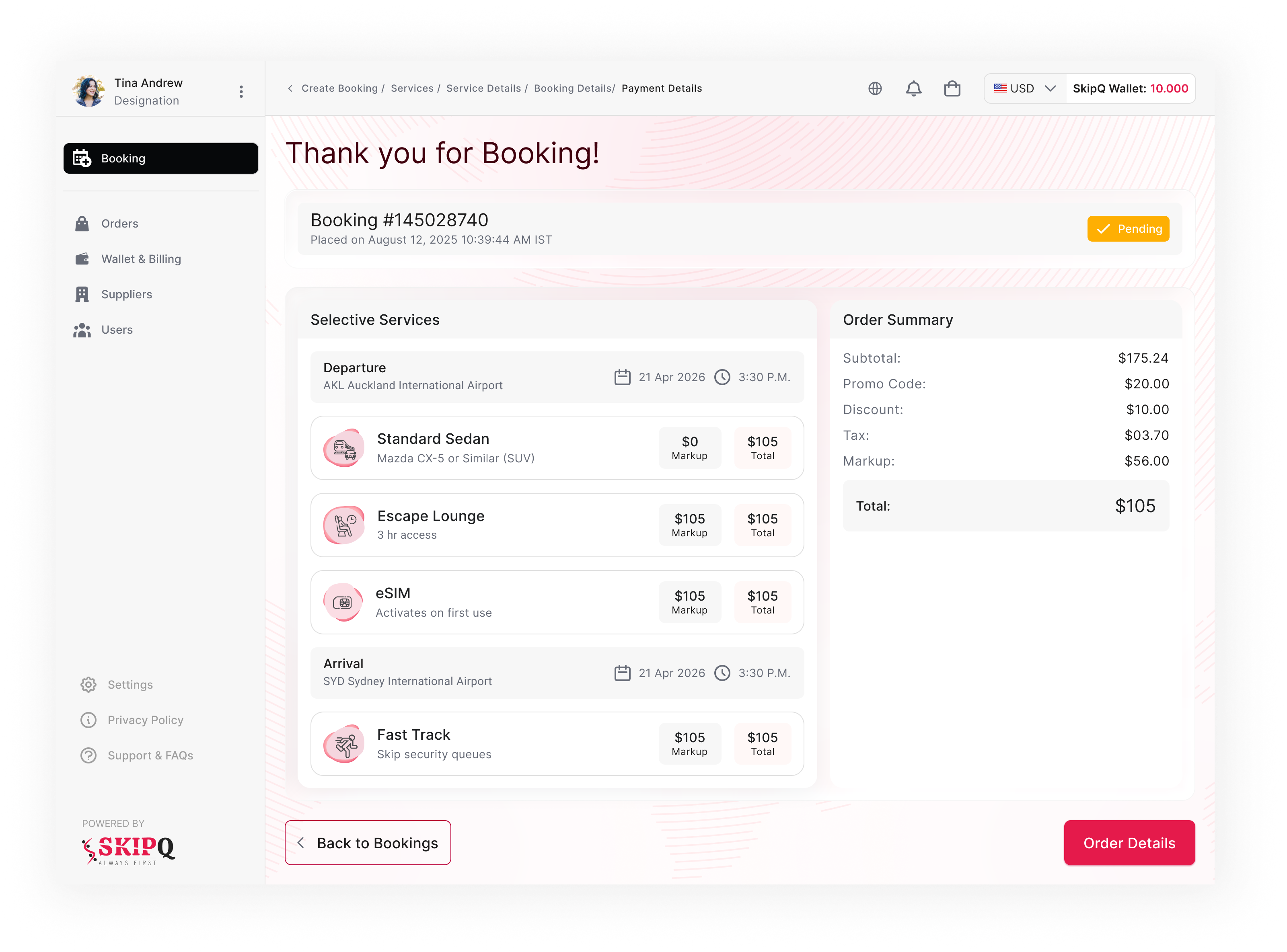
Payment and Confirmation
I designed clear payment, wallet, and confirmation states that preserve booking context, communicate transaction status, and help users understand the next step.
Post-Booking Support System
I also designed the internal operations experience used to manage bookings, suppliers, customer communication, pricing, and support workflows across the SkipQ ecosystem.
.png)
Order Management
I designed a centralised, scalable system for managing bookings throughout the post-purchase journey. It supports complex, multi-service orders across suppliers while maintaining a clear and consistent customer experience.
Customers can access:
- Order history.
- Booking details.
- Payment status.
- Service summaries.
- Post-booking actions.
This gives users a simple way to track, review, and manage purchases across services and booking scenarios.
.png)
Wallet and Billing
I designed Wallet and Billing to simplify payment management within the SkipQ ecosystem. Customers can securely manage payment methods, add or store cards, and top up their SkipQ wallet.
The experience provides:
- Clear payment flows.
- Visible wallet balances.
- Transaction history.
- Simplified checkout interactions.
These features reduce payment friction and support purchases across multiple services.
Final Outcome
The final solution established a scalable, user-centred booking platform that supports 21 supplier integrations across seven service verticals within one consistent experience. A flexible design system, standardised booking architecture, and reusable components improved consistency across search, booking, checkout, confirmation, and post-booking workflows.
By simplifying complex booking logic and reducing friction, the redesigned experience contributed to a 20% increase in booking completion. The modular framework also improved design and development efficiency and created a strong foundation for future supplier integrations and product expansion.
.png)